Construction Invoice Guide: How Contractors Bill for Progress, Retainage, and Change Orders

 KipBill Team
Construction invoicing is nothing like sending a bill for consulting hours or a graphic design project. You are dealing with multi-phase projects that run for months, costs that shift as work progresses, retainage holdbacks, change orders that appear mid-project, and lien rights that depend on proper documentation. Get your invoicing wrong and you do not just wait longer for payment — you can lose your legal right to collect.
This guide covers the specific invoicing practices construction contractors and subcontractors need to know, with real examples you can apply to your next project.
Why Construction Invoicing Is Different
Most service businesses invoice after work is complete. Construction rarely works that way. Here is what makes it different:
- Progress billing: You bill as work progresses, not at the end. A six-month project might generate monthly invoices based on percentage of completion.
- Retainage: The owner or GC holds back a percentage (usually 5-10%) of each payment until the project is substantially complete.
- Change orders: Scope changes during construction are normal, and each one needs to be invoiced separately from the original contract amount.
- Lien rights: Your invoicing documentation directly affects your ability to file a mechanic's lien if payment goes sideways.
- Multiple cost categories: A single invoice may include labor, materials, equipment rental, subcontractor costs, and overhead markup — each tracked separately.
If you are using a generic invoice template that just lists hours and a rate, you are creating problems for yourself. Even the fundamentals covered in a standard guide on how to create a professional invoice are not enough for construction — you need industry-specific structures.
Progress Invoicing: Billing by Percentage of Completion
Progress billing is the standard in construction. Instead of waiting until the project wraps up, you submit invoices at regular intervals — usually monthly — that reflect the percentage of work completed.
Here is how it works in practice:
- Start with the contract amount: Your signed contract establishes the total price for each scope item or division of work.
- Estimate completion percentage: At each billing period, you assess how much of each line item is complete. If the contract includes $40,000 for framing and you have completed roughly 75% of the framing work, you bill $30,000 for that line item.
- Subtract previous billings: Your current invoice only requests the difference between the total earned to date and what has already been billed. If you billed $20,000 for framing last month and it is now 75% complete ($30,000 earned), this month's invoice requests $10,000 for framing.
- Apply retainage: Subtract the retainage percentage from the amount due this period.
Keep a running schedule of values — a spreadsheet or table that tracks each line item's contract amount, previous billings, current billing, and total billed to date. This is what GCs and owners expect to see, and it prevents disputes about what has already been paid.
The math for a single line item looks like this:
Current amount due = (Contract amount x % complete) - Previous billings - Retainage
Do this for every line item and sum it up. That total is your invoice amount.
Breaking Down a Construction Invoice
A proper construction invoice separates costs into categories. This is not optional — GCs, property owners, and lenders all expect to see where the money goes.
Labor
List labor by trade or task, not as one lump number. Include the number of hours or days, the rate, and the total. If you have different crew members at different rates, break that out.
Materials
Itemize materials with quantities and unit costs. Keep receipts. If the contract is cost-plus, you will need to attach backup documentation. Even on fixed-price contracts, having material breakdowns prevents arguments about scope.
Equipment
Equipment rental and owned-equipment usage charges get their own line items. Include the equipment type, rental period or hours used, and the rate.
Subcontractors
If you are a GC billing the owner, include subcontractor costs as separate line items. Attach the sub's invoice as backup. If you are a sub billing a GC, this section does not apply — but you still need the other categories.
Overhead and Markup
Your contract likely includes an agreed-upon markup percentage for overhead and profit. Apply this to the appropriate cost categories as specified in your contract. Common markups range from 10% to 20% on top of direct costs.
Change Orders: Invoicing Scope Changes
Every construction project has changes. A client wants to upgrade the countertops. The engineer requires additional structural work. The architect modifies the layout. Each of these is a change order, and each needs to be invoiced correctly.
The key rule: never mix change order costs with original contract billing. They should appear as separate line items or on a separate section of your invoice, clearly referencing the approved change order number.
A change order line item should include:
- The change order number and approval date
- A description of the additional or modified work
- The agreed-upon price for the change
- The percentage of the change order work that is complete (if billing in progress)
If a change order has not been formally approved and signed, do not invoice it. You can note it as pending, but billing unapproved changes is a fast way to create a payment dispute.
Number your change orders sequentially (CO-001, CO-002, etc.) and keep a log with dates, descriptions, and approval status. When you invoice, reference the CO number so the GC or owner can match it to their records instantly.
Retainage: Handling the Holdback
Retainage (also called retention) is the percentage of each progress payment that the owner or GC withholds until the project reaches substantial completion. Standard retainage is 5% or 10%, depending on the contract and jurisdiction.
How retainage affects your invoices
On every progress invoice, you calculate the full amount earned but only request payment for the amount minus retainage. For example, if you earned $50,000 this billing period and retainage is 10%, you request $45,000 and $5,000 goes into the retainage bucket.
When to invoice retainage
You submit a separate retainage invoice (or a final invoice that includes accumulated retainage) after the project reaches substantial completion and any punch list items are resolved. Some contracts release retainage in two stages — half at substantial completion and the rest after final completion.
Track retainage carefully
Your schedule of values should have a retainage column that shows the running total held back. By the end of the project, this number can be significant. On a $500,000 contract with 10% retainage, that is $50,000 sitting in someone else's account until the project wraps up.
Know your state's retainage laws. Many states cap retainage percentages and require timely release after completion. Some prohibit retainage on certain project types entirely.
AIA-Style Billing vs Simple Invoicing
The American Institute of Architects (AIA) publishes standardized billing forms that are widely used in commercial construction. The two most common are:
- AIA G702 (Application and Certificate for Payment): The summary cover sheet showing total contract, changes, completed work, retainage, and amount due.
- AIA G703 (Continuation Sheet): The detailed schedule of values with line-by-line progress.
When you need AIA forms
If you are working on commercial projects, government contracts, or any job where the contract specifies AIA billing, you must use these forms. Submitting a regular invoice will get rejected.
When simple invoicing works
For residential work, small commercial jobs, and projects where the contract does not require AIA forms, a well-structured progress invoice covers everything you need. It should still include a schedule of values, previous billings, current billing, and retainage — just in your own format rather than on AIA forms.
Most residential contractors and smaller subs will never need AIA forms. But if you are moving into commercial work, learn them. Using invoice software for construction that supports progress billing and retainage tracking makes the transition easier regardless of which format you use.
Start invoicing for free
Join thousands of freelancers and small businesses who create professional invoices with KipBill.
Lien Waivers and Their Connection to Invoicing
A mechanic's lien is your legal right to place a claim on the property if you do not get paid. Lien waivers are documents you sign to waive that right — typically exchanged for payment.
There are four types of lien waivers:
- Conditional waiver on progress payment: You waive lien rights for a specific amount, but only once that payment actually clears.
- Unconditional waiver on progress payment: You waive lien rights for a specific amount immediately, regardless of whether payment clears.
- Conditional waiver on final payment: Same as above but for the final payment.
- Unconditional waiver on final payment: Waives all remaining lien rights.
The invoicing connection: GCs and owners will often require a lien waiver with each progress invoice. You submit your invoice, and along with it you provide a conditional waiver for the current amount requested and an unconditional waiver for the previous payment that has already cleared.
Never sign an unconditional waiver until you have confirmed the corresponding payment has been deposited and cleared your bank. This is non-negotiable.
Payment Terms for Construction
Standard payment terms in construction differ from other industries:
- Net 30: The most common term for commercial work. The GC or owner has 30 days from invoice receipt to pay.
- Progress payments: Monthly billing cycles tied to the project schedule, typically with Net 30 from invoice submission.
- Milestone-based: Payment triggers at specific project milestones (foundation complete, framing complete, dried in, etc.) rather than on a calendar schedule.
- Pay-when-paid vs pay-if-paid: Some subcontracts tie your payment to when the GC gets paid by the owner. Know the difference — "pay-when-paid" means the GC must pay you within a reasonable time regardless. "Pay-if-paid" means if the owner stiffs the GC, the GC might not owe you. Many states have restricted or banned pay-if-paid clauses.
Include your payment terms on every invoice and reference the contract clause. If the contract says Net 30 and you are on day 45 without payment, that reference gives you a clear basis for a follow-up — and our late payment email templates can help you word that message. Tools like KipBill can send automatic payment reminders so you do not have to chase every overdue invoice manually.
Real Examples
Example 1: Residential Remodel Progress Invoice
Project: Kitchen and bathroom remodel, $85,000 fixed-price contract, 10% retainage
| Description | Contract Amount | % Complete | Earned to Date | Previous Billed | This Invoice | Retainage (10%) |
|---|---|---|---|---|---|---|
| Demo and disposal | $4,500 | 100% | $4,500 | $4,500 | $0 | $450 |
| Rough plumbing | $8,000 | 100% | $8,000 | $5,600 | $2,400 | $800 |
| Electrical rough-in | $6,500 | 80% | $5,200 | $3,900 | $1,300 | $520 |
| Framing and drywall | $12,000 | 60% | $7,200 | $0 | $7,200 | $720 |
| Tile and flooring | $14,000 | 0% | $0 | $0 | $0 | $0 |
| Cabinets and counters | $22,000 | 0% | $0 | $0 | $0 | $0 |
| Finish plumbing | $5,000 | 0% | $0 | $0 | $0 | $0 |
| Finish electrical | $4,000 | 0% | $0 | $0 | $0 | $0 |
| Painting and trim | $6,000 | 0% | $0 | $0 | $0 | $0 |
| Cleanup and punch list | $3,000 | 0% | $0 | $0 | $0 | $0 |
| Totals | $85,000 | $24,900 | $14,000 | $10,900 | $2,490 |
Amount due this period: $10,900 - $1,090 (retainage on this period) = $9,810
This gives the homeowner a clear picture of where the project stands and exactly what they owe.
Example 2: Commercial Subcontractor Invoice
Project: HVAC installation for office buildout, $220,000 subcontract, 5% retainage, one approved change order
| Description | Contract Amount | % Complete | Earned to Date | Previous Billed | This Invoice | Retainage (5%) |
|---|---|---|---|---|---|---|
| Ductwork fabrication and install | $95,000 | 70% | $66,500 | $47,500 | $19,000 | $3,325 |
| Equipment (RTUs, VAVs) | $72,000 | 50% | $36,000 | $36,000 | $0 | $1,800 |
| Controls and thermostats | $28,000 | 20% | $5,600 | $0 | $5,600 | $280 |
| Insulation | $15,000 | 65% | $9,750 | $7,500 | $2,250 | $487.50 |
| Testing and balancing | $10,000 | 0% | $0 | $0 | $0 | $0 |
| Original contract total | $220,000 | $117,850 | $91,000 | $26,850 | $5,892.50 | |
| CO-001: Additional exhaust fan | $4,200 | 100% | $4,200 | $0 | $4,200 | $210 |
| Grand total | $224,200 | $122,050 | $91,000 | $31,050 | $6,102.50 |
Amount due this period: $31,050 - $1,552.50 (retainage on this period) = $29,497.50
Notice the change order is listed separately with its own CO number. The GC can match it to the approved change order documentation without any confusion.
Getting Your Construction Invoicing Right
Construction invoicing does not need to be complicated, but it does need to be precise. Track your schedule of values, keep change orders separate, understand your retainage terms, and always tie your lien waivers to confirmed payments.
The contractors who get paid consistently are not necessarily the ones doing the best work — they are the ones sending clear, complete invoices on schedule with proper documentation. Whether you use KipBill, AIA forms, or a spreadsheet you built yourself, the principles are the same: be detailed, be accurate, and be consistent. For general invoicing best practices that apply across industries, see our invoicing tips for freelancers.
Start with the examples above, adapt them to your contract terms, and submit your invoices on time every billing cycle. Your cash flow depends on it.

KipBill Team
Related Articles
Invoicing for Personal Trainers and Gyms: Session Packages, Memberships, and Getting Paid Reliably
A complete guide to invoicing for personal trainers, gym owners, and fitness professionals. Learn how to bill for session packages, memberships, group classes, online coaching, and more.
Invoicing for Real Estate Agents: Commissions, Referral Fees, Staging Costs, and More
A practical guide to invoicing for real estate agents and property managers. Learn how to bill for commissions, referral fees, staging, photography, marketing expenses, and closing cost breakdowns.
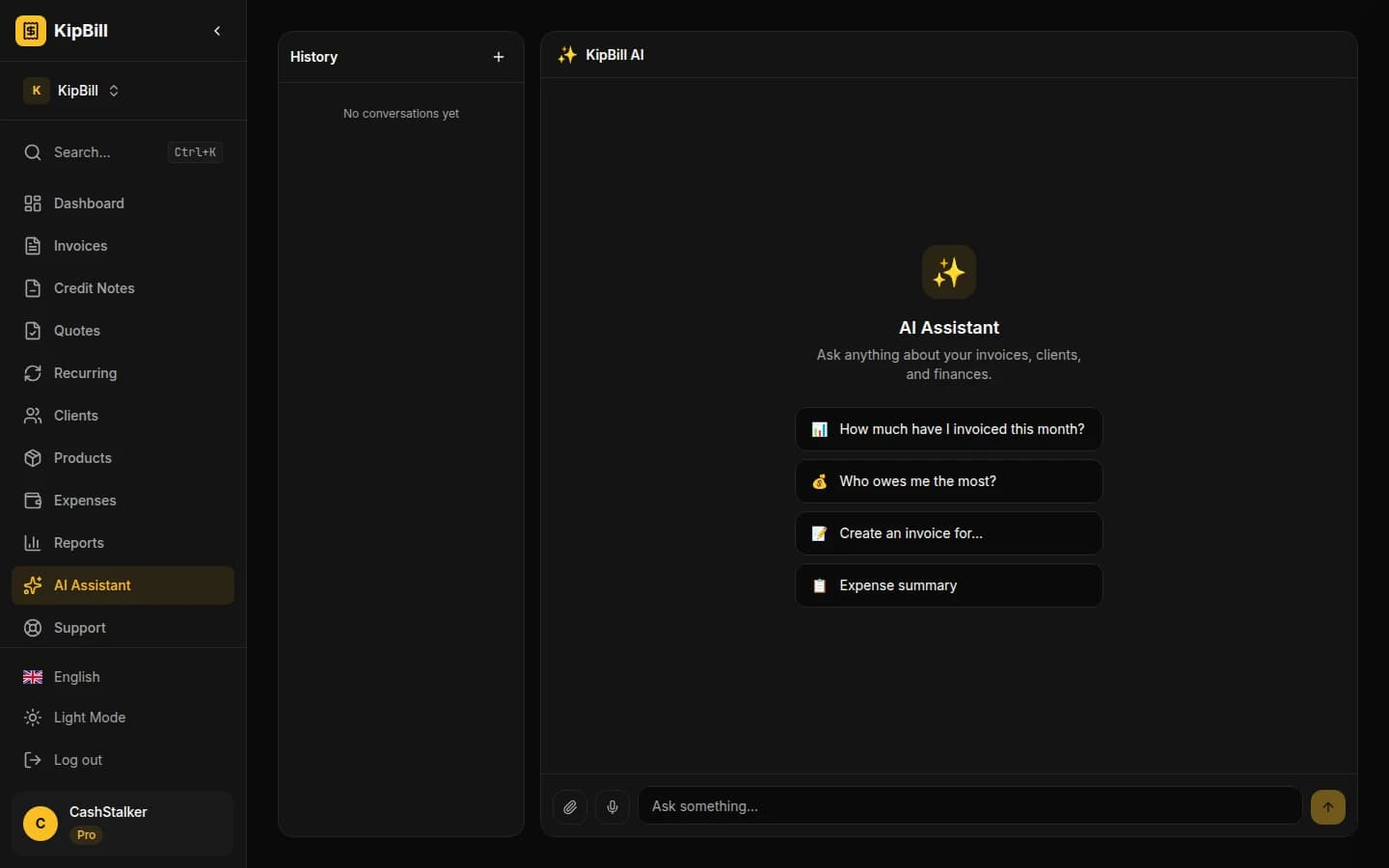
AI Invoice Generator: Create and Send Invoices with Voice and Chat
KipBill's AI invoice generator lets you create, send, and manage invoices by voice or chat. Powered by Claude and OpenAI Whisper. 45 AI tools, 12 languages, free plan available.
Start invoicing for free
Join thousands of freelancers and small businesses who create professional invoices with KipBill.