How to Invoice for Graphic and Web Design Work
 KipBill Team
Design invoicing has a unique problem that most other professions do not face: the work is subjective. A plumber fixes a leak and the leak is either fixed or it is not. A designer delivers a logo and the client says "I don't know, it just doesn't feel right." This subjectivity bleeds into every aspect of billing — scope disputes, revision spirals, clients who want "just one more small change," and the constant tension between valuing your creative expertise and justifying your rates to people who think their nephew could do it in Canva.
This guide covers how graphic designers, web designers, brand designers, and other creative professionals should structure their invoicing to get paid fairly and on time, with practical systems you can implement on your next project. For general invoice fundamentals, see our guide on how to create a professional invoice.
Project-Based vs Hourly: Choosing the Right Billing Model
The first decision you make on every project — how to price it — determines everything about how you invoice. Both models have legitimate uses, and many designers use a hybrid.
When hourly billing makes sense
Hourly billing works best when:
- The scope is genuinely undefined (exploratory research, ongoing retainer work, consulting calls)
- The client has a history of scope changes and you want to be compensated for every hour
- You are doing production work (resizing assets, making specified edits) where the deliverables are clear but the volume is unpredictable
If you bill hourly, your invoices should include the same level of detail you would expect from a lawyer: date, description of work performed, and time spent. "Design work — 4 hours" tells the client nothing. "Developed three logo concepts based on creative brief, exploring serif typography direction, geometric mark direction, and hand-lettered direction — 4 hours" shows exactly what they are paying for.
When project-based billing makes sense
Project-based (flat fee) billing works best when:
- The deliverables are well-defined (a logo package, a 10-page website, a set of social media templates)
- You have enough experience to estimate the time accurately
- You want the upside — if you work efficiently, your effective hourly rate increases
The trap with project billing is scope creep. If your proposal says "logo design" without defining what that includes, you will end up doing twelve rounds of revisions for a fee that assumed three. Your invoice and your proposal need to work together.
The hybrid approach
Many experienced designers use a hybrid: project-based pricing for the defined scope with an hourly rate for anything outside it. Your proposal might read:
"Brand identity package (logo, color palette, typography, brand guidelines document): $4,500 flat fee. Includes up to three concept presentations and two rounds of revisions per selected concept. Additional revisions or deliverables beyond this scope will be billed at $125/hour."
This gives the client cost certainty for the agreed work while protecting you from endless revisions.
Always define "a round of revisions" in your proposal. One round means the client provides consolidated feedback once, and you address all of it in one pass. Without this definition, clients will send feedback in five separate emails over two weeks, each triggering new work, and then insist it was all "one round."
Milestone Payments: Getting Paid as You Go
Never do an entire design project and then invoice at the end. Milestone billing protects you from non-payment and gives the client natural checkpoints to confirm the project is on track.
A standard milestone structure
For most design projects, a three-milestone structure works well:
| Milestone | When | Percentage | Purpose |
|---|---|---|---|
| Deposit | Project kickoff | 30-50% | Secures your calendar, covers initial research and concepting |
| Midpoint | After concept approval | 25-35% | Covers refinement and production |
| Final | On delivery | 25-35% | Released upon delivery of final files |
For larger projects (full brand identity, multi-page websites), consider four or five milestones tied to specific deliverables:
- Project kickoff: 25% deposit
- Concept presentation: 25% upon presenting initial concepts
- Design approval: 25% upon approving the refined direction
- Final delivery: 25% upon delivering final files and assets
Invoice each milestone separately
Send a distinct invoice for each milestone with a clear description of what the payment covers and what deliverables are included. Do not send one invoice at the start with multiple payment dates — that creates confusion about what has been paid.
Your deposit invoice should reference the signed proposal or contract and state that work begins upon receipt of payment. This is not aggressive — it is standard practice that protects both parties.
Revision Policies: Protecting Your Time
Revisions are where design projects go off the rails financially. Without a clear policy, you will do ten rounds of changes on a project priced for three.
How to structure revision terms
Your contract and invoice should reference your revision policy:
- Included revisions: State exactly how many rounds are included in the project fee. Two to three rounds is standard for most design work.
- What counts as a round: One consolidated set of feedback, addressed in one pass. Clarify that multiple emails with piecemeal feedback count as multiple rounds.
- Additional revision rate: State the hourly rate for revisions beyond the included rounds. Many designers charge their standard hourly rate; some charge a premium (1.5x) for excessive revisions as an incentive for clients to provide thoughtful, consolidated feedback.
- Scope change threshold: Define when a revision becomes a new deliverable. "Change the logo color from blue to green" is a revision. "Actually, we want a completely different concept" is a new project.
Invoicing additional revisions
When you exceed the included revision rounds, send a separate invoice (or a line item on your next milestone invoice) specifically for the additional revisions. Include:
- A note referencing that the included revision rounds have been used
- The date and description of each additional revision request
- The time spent on each
- The applicable hourly rate
Notify the client before doing the additional revision work, not after. A quick email — "This would be revision round four, which falls outside the project scope. I am happy to proceed at my hourly rate of $125/hour. Want me to go ahead?" — prevents disputes and gives the client a chance to prioritize their feedback.
Licensing Fees and Usage Rights
Here is where design invoicing diverges sharply from other professions: you are not just billing for time spent, you are billing for intellectual property. How you handle licensing on your invoices matters.
Separating design fees from licensing
Some designers, particularly illustrators and photographers, separate the creative fee (the cost of producing the work) from the licensing fee (the cost of using it). This is especially relevant for:
- Logo design: Most logo projects include a full trademark license as part of the project fee. Make this explicit on your invoice or proposal.
- Illustrations: An illustration for a blog post costs less than the same illustration on product packaging distributed nationally, because the usage rights are different.
- Stock or template work: If you create design templates for a client, specify whether they can modify them, how many times they can use them, and whether exclusivity is included.
How to show licensing on an invoice
If licensing is separate from the design fee, list it as its own line item:
| Description | Amount |
|---|---|
| Editorial illustration — hero image for annual report | $1,800.00 |
| Usage license — print and digital, North America, 2 years | $900.00 |
| Total | $2,700.00 |
If licensing is bundled into the project fee (standard for most brand identity and web design work), note it in the description: "Brand identity design package including full perpetual usage license for all delivered assets."
Either way, be explicit. Do not leave ownership and usage rights ambiguous on your invoices — this leads to disputes months or years later.
Rush Charges and Expedited Timelines
Rush projects are common in design. A startup needs pitch deck graphics by Friday. A retailer realizes they need holiday campaign assets two weeks before the sale launches. These deserve premium pricing, and your invoicing should reflect that clearly.
Standard rush fee structures
- 24-48 hour turnaround: 50-100% surcharge on the project fee
- Under one week (for work that normally takes 2-3 weeks): 25-50% surcharge
- Weekend or holiday work: 50% surcharge on the applicable hourly or project rate
How to invoice rush work
List the rush fee as a separate line item, not buried in the project rate:
| Description | Amount |
|---|---|
| Social media campaign — 12 Instagram story templates | $1,200.00 |
| Rush fee — 48-hour turnaround (50% surcharge) | $600.00 |
| Total | $1,800.00 |
This transparency actually makes the rush charge easier for clients to accept. They can see the standard price and understand exactly what the expedited timeline costs. Hiding it in an inflated project rate feels dishonest if they later compare it to your normal pricing.
Start invoicing for free
Create professional invoices in minutes with KipBill, like freelancers and small businesses in 40+ countries.
Common Design Invoicing Mistakes
These are the errors that cost designers the most money and create the most client friction:
Not collecting a deposit
Starting work without a deposit is the single biggest financial mistake freelance designers make. If the client disappears after you have spent 20 hours on concepts, you have zero leverage and zero compensation. A 30-50% deposit collected before any work begins is non-negotiable for project-based work.
Vague scope descriptions on invoices
"Website design — $5,000" on an invoice means nothing when there is a dispute. "Website design — 8-page marketing website including homepage, about, services (3 pages), portfolio, blog index, and contact page, with responsive design for desktop, tablet, and mobile" leaves no room for ambiguity about what is included.
Not invoicing for unused concepts
If your contract includes three logo concepts and the client picks one, you have still done the work on all three. Your project fee should account for the concept development phase, not just the one direction that was selected. If a client wants to use a rejected concept later, that is a separate licensing discussion.
Delivering final files before final payment
Never send production-ready files (vector logos, layered Photoshop files, website source code) until the final invoice is paid in full. Present work using watermarked PDFs or low-resolution previews until payment clears. This is your primary leverage for collecting final payment.
Forgetting to invoice for expenses
Stock photography, premium fonts purchased for the project, printing costs for physical mockups, travel to client presentations — these are all legitimate project expenses. Either build them into your project fee or list them as separate line items with receipts.
Inconsistent invoice formatting
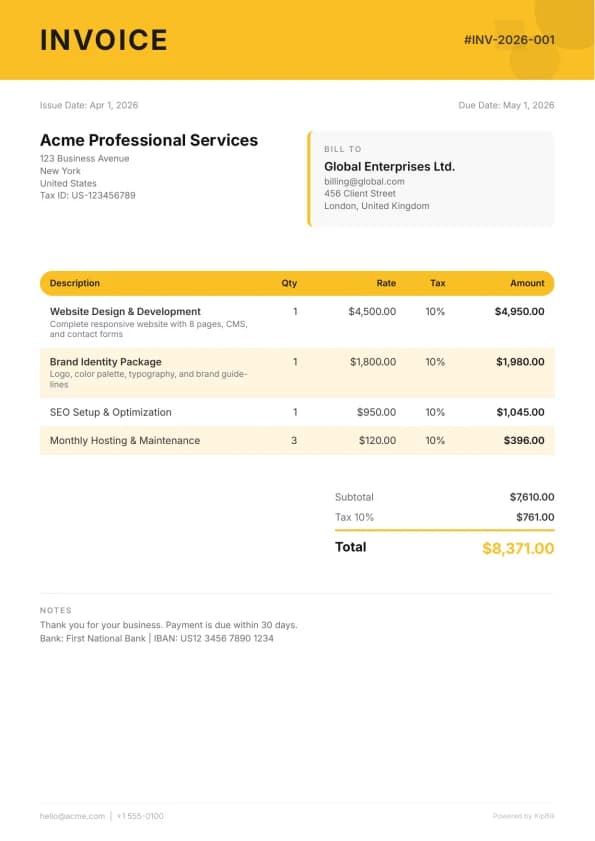
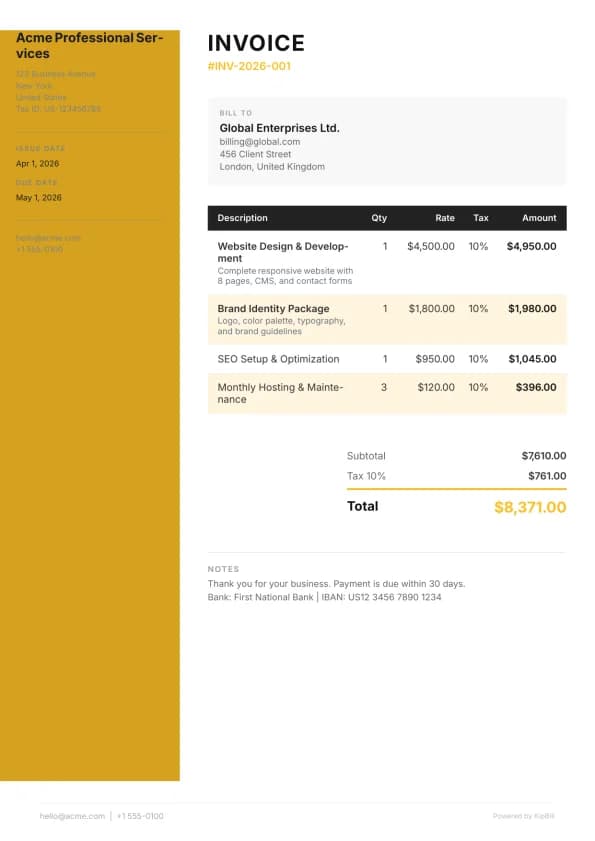
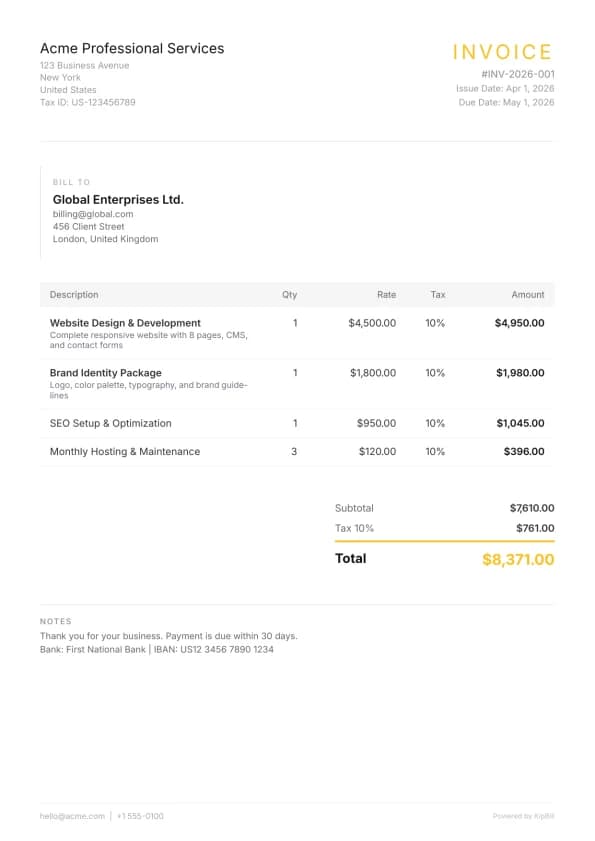
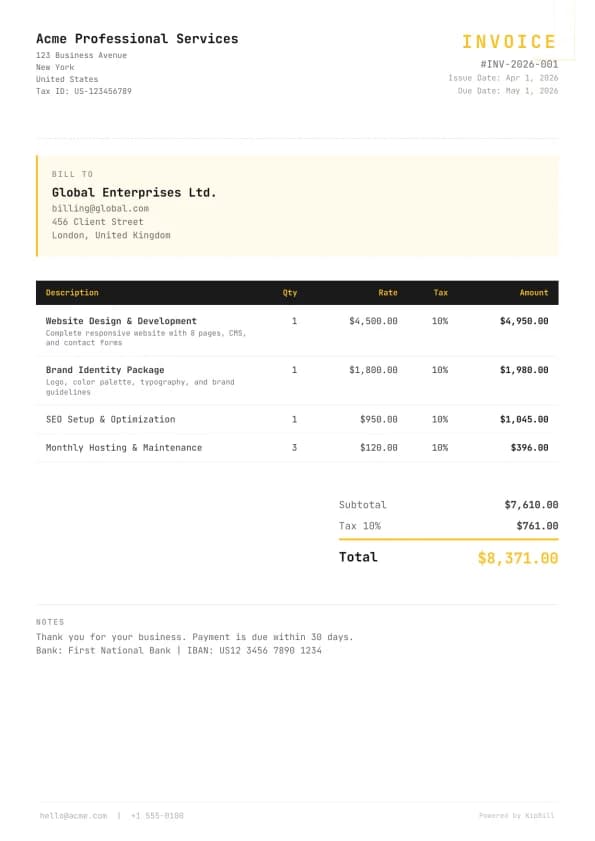
Your invoices represent your design skills. If you are a graphic designer sending sloppy, generic invoices, clients will question your attention to detail. Use consistent branding, clean typography, and professional formatting on every invoice. Tools like KipBill let you customize invoice templates to match your brand identity, which also keeps your invoicing workflow fast and consistent.
Setting Up Your Design Invoicing Workflow
A practical system for freelance designers:
- Proposal and contract first: Never start invoicing without a signed proposal that defines scope, deliverables, revision rounds, timeline, and payment milestones.
- Deposit invoice on signing: Send the deposit invoice immediately when the contract is signed. Do not begin work until it is paid.
- Milestone invoices at each checkpoint: As each milestone is reached, send the corresponding invoice before delivering final files for that phase.
- Additional work tracked separately: If the project goes beyond scope, track hours and send a supplementary invoice with clear descriptions.
- Final invoice before final delivery: Send the final invoice and release production files only upon payment.
For managing recurring design clients, KipBill's recurring invoice feature lets you automate monthly retainer billing so you never miss a cycle. The AI invoicing assistant can also help draft invoices and follow up on outstanding payments. And if you are just getting started, our free invoice generator creates professional invoices in seconds.
Check out our dedicated invoice software for designers page to see how KipBill handles the specific needs of creative professionals.
Frequently Asked Questions
Should designers charge hourly or per project?
It depends on the type of work. Project-based pricing is better for well-defined deliverables like logo design, brand identity, or website design — it rewards efficiency and gives clients cost certainty. Hourly billing works better for ongoing work, consulting, or projects where the scope is genuinely uncertain. Many successful designers use both: project rates for defined work and hourly rates for anything outside scope.
How much deposit should a designer require upfront?
The industry standard is 30-50% of the total project fee. For projects under $2,000, many designers require 50% upfront. For larger projects with multiple milestones, 25-30% is common for the initial deposit. The key is that no work begins until the deposit is paid — this is universally accepted practice in the design industry.
How do designers handle clients who want unlimited revisions?
You do not offer unlimited revisions. Define a specific number of revision rounds in your contract (two to three is standard), clearly define what constitutes a round, and state the hourly rate for additional rounds. If a client insists on unlimited revisions, increase your project fee significantly to account for the additional time, or decline the project. Unlimited revisions devalue your expertise and create unsustainable projects.
What should a designer do when a client ghosts after receiving concepts?
This is why deposits exist. If you collected a deposit, you are compensated for the concept phase. Follow up with a professional email, then a second follow-up two weeks later. After 30 days of no response, send a final notice stating that the project will be archived and any remaining balance is still owed per the contract. Never release final files for a project with an outstanding balance, even if the client resurfaces months later.
Should licensing fees be separate from design fees on an invoice?
For most graphic and web design work — brand identity, websites, marketing materials — licensing is typically bundled into the project fee with a clear statement that the client receives full usage rights upon final payment. For illustration, photography, and work where usage scope significantly affects value, separating the creative fee from the licensing fee gives you flexibility to price based on how the work will be used. The important thing is to address usage rights explicitly, whether bundled or separated.

KipBill Team
Related Articles
Accounting Firm Invoice Guide: How Accountants and CPAs Should Bill Clients
Practical guide to invoicing for accountants — recurring billing, engagement letters, tax season pricing, value-based fees, bundled services, and common billing mistakes CPA firms make.
Invoicing for Cleaning Services: Billing for Recurring, Deep Cleans, and Move-In/Move-Out Jobs
Practical guide to cleaning service invoicing — how to price by square footage, bill for recurring schedules, handle supply charges, and invoice for deep cleans and move-in/move-out cleaning jobs.
Invoicing for Electricians: How to Bill for Service Calls, Projects, and Permit Fees
Complete guide to electrical contractor billing — how to handle material markup, permit fees, service call rates, progress billing for large projects, and safety inspection charges on your electrician invoices.
Start invoicing for free
Create professional invoices in minutes with KipBill, like freelancers and small businesses in 40+ countries.