Invoicing for Electricians: How to Bill for Service Calls, Projects, and Permit Fees
 KipBill Team
Most electricians are excellent at their trade and terrible at paperwork. That is not an insult — it is the reality of running a business where the real work happens inside walls, crawl spaces, and panel boxes. But sloppy invoicing costs electrical contractors thousands of dollars every year in disputed charges, forgotten materials, unbilled permit fees, and clients who "forgot" they owed you.
This guide covers how to build invoices that protect your revenue, keep clients informed, and make your accounting painless. If you need a refresher on invoice fundamentals first, see our guide on how to create a professional invoice.
Service Calls vs Project-Based Work: Two Different Invoice Structures
Electrical work splits into two broad categories, and each demands a different invoicing approach.
Service Call Invoicing
A homeowner's breaker keeps tripping. A restaurant's outlet stopped working. A property manager needs a ceiling fan installed. These are service calls — short jobs, usually completed in one visit, billed immediately.
A service call invoice should include:
- Service call fee — your minimum charge for showing up (typically $75-$150 depending on your market). List this as a separate line item, not buried in the labor rate.
- Labor — hours on-site multiplied by your hourly rate. Be specific: "2.5 hours on-site electrical labor" not just "labor."
- Materials — every wire nut, breaker, outlet, and foot of Romex. List each item with quantity and price.
- Diagnosis/troubleshooting time — if you spent 45 minutes figuring out that a buried junction box was the culprit, bill for it. Many electricians eat this time and only bill for the fix. Stop doing that.
Project-Based Invoicing
Panel upgrades, whole-house rewires, new construction rough-ins, commercial tenant improvements — these are projects with defined scopes, and they need structured billing.
For projects over $2,000, use progress billing (also called draw invoicing):
- Deposit invoice — 25-50% upfront before ordering materials or starting work
- Rough-in invoice — billed after rough wiring is installed and before walls are closed
- Trim-out/final invoice — billed after devices are installed, panels are landed, and the system passes inspection
Each progress invoice should reference the original estimate or contract number, show the total project cost, amount invoiced to date, and remaining balance. This gives the client a clear picture of where the project stands financially.
How to Handle Material Markup
Materials are a significant portion of electrical work — wire, panels, breakers, conduit, boxes, connectors, devices, and specialty items like transfer switches or sub-panels. How you present material costs on invoices matters.
The Standard Markup Approach
Most electrical contractors mark up materials 15-30% above their wholesale cost. This markup covers your time purchasing materials, fuel to pick them up, waste, and the risk of carrying inventory. It is a completely standard trade practice.
On the invoice, you have two choices:
Option A: Show retail pricing. List materials at your marked-up price without showing your cost. This is simpler and avoids the "I can buy that breaker at Home Depot for less" conversation.
Option B: Show cost plus markup. List your wholesale cost and a separate markup line item (e.g., "Materials markup 20%"). This is more transparent and works well with commercial clients and general contractors who expect to see cost-plus billing.
| # | Description | Qty | Unit Price | Total |
|---|---|---|---|---|
| 1 | 200A Square D Homeline panel | 1 | $285.00 | $285.00 |
| 2 | 20A single-pole breaker | 12 | $8.50 | $102.00 |
| 3 | 12/2 NM-B Romex (250ft box) | 3 | $89.00 | $267.00 |
| 4 | Miscellaneous supplies (boxes, connectors, wire nuts, straps) | 1 | $145.00 | $145.00 |
| Materials subtotal | $799.00 | |||
| Materials handling (20%) | $159.80 |
Always include a "miscellaneous supplies" line item on project invoices. Tracking every individual wire nut and cable staple is not practical, but those small items add up to $100-$300 on a typical residential project. A blanket line item for small consumables is both honest and efficient.
Client-Supplied Materials
When a client insists on buying their own materials (common with homeowners who want a specific fixture or smart home device), note this clearly on the invoice and include a disclaimer that your warranty does not cover client-supplied equipment. Something like: "Client-supplied Lutron Caseta dimmer — installation labor only, no warranty on device."
Permit Fees and Inspection Charges
Electrical permits are required for most work beyond simple device replacements. The cost varies wildly — $50 for a basic residential permit in a small town, $500+ for a commercial panel upgrade in a major city. How you handle this on invoices is important.
Best Practice: Pass Through at Cost
List the permit as a separate line item at the exact cost you paid. Do not mark up permits — it is considered unethical in most markets and can violate contractor licensing regulations in some states.
| # | Description | Qty | Unit Price | Total |
|---|---|---|---|---|
| 1 | Electrical permit — City of Austin, residential panel upgrade | 1 | $175.00 | $175.00 |
| 2 | State electrical inspection fee | 1 | $50.00 | $50.00 |
If a project requires multiple inspections (rough-in inspection plus final inspection), list each separately with a description of what it covers.
When Permits Are Not Pulled
Some clients ask you to skip permits to save money. Beyond the legal and safety issues, this creates an invoicing problem — unpermitted work reduces your leverage if a payment dispute arises. If you agree to work without a permit (which you should not), document the client's request in writing and reflect it in your invoice notes. Better yet, make it a policy to always pull permits and include it in every estimate.
Wiring Specifications and Job Documentation
Your invoice doubles as a record of what was installed. Including basic wiring specifications helps with future service calls, inspections, and warranty claims.
What to Document on the Invoice
For each circuit or system installed, include:
- Wire gauge and type — "12/2 NM-B" or "10/3 MC cable"
- Circuit designation — "Kitchen counter receptacle circuit, 20A, Panel A, breaker #8"
- Code reference when relevant — "GFCI protection per NEC 210.8(A)" or "AFCI protection per NEC 210.12(A)"
- Fixture or equipment model — for installed items like panels, generators, or transfer switches
This level of detail might seem excessive for an invoice, but it serves three purposes: it justifies your pricing (the client can see exactly what was installed), it creates a reference document for future work, and it demonstrates professionalism that separates you from unlicensed handymen.
Digital Photos as Supporting Documentation
Attach photos of completed work — especially hidden rough-in wiring before walls are closed. Many invoicing tools including KipBill allow you to attach files to invoices. A photo of a neat panel layout or properly supported wire runs reinforces the quality of your work and provides evidence if a dispute arises later.
Safety Inspection and Code Compliance Billing
Some electrical work requires more than the standard permit inspection. Older homes may need a safety audit before insurance renewal. Commercial properties require periodic electrical inspections. These services deserve their own invoicing structure.
Electrical Safety Inspections
A full residential electrical safety inspection takes 2-4 hours and involves checking the panel, grounding system, visible wiring, outlets, switches, and smoke detectors. Invoice this as a flat fee with an itemized report of findings.
| # | Description | Qty | Unit Price | Total |
|---|---|---|---|---|
| 1 | Comprehensive electrical safety inspection — residential (up to 2,500 sq ft) | 1 | $350.00 | $350.00 |
| 2 | Written inspection report with code compliance findings | 1 | Included | $0.00 |
| 3 | Infrared thermal scan of main panel and sub-panels | 1 | $125.00 | $125.00 |
Code Correction Billing
When an inspection reveals code violations, the correction work should be quoted and invoiced separately from the inspection. Never bundle inspection and correction on the same invoice — they are different services, and combining them makes it look like you found problems just to create more work.
Common Invoicing Mistakes Electricians Make
After working with hundreds of electrical contractors, these are the billing errors that come up again and again.
1. Not billing for drive time on distant jobs. If a client is 45 minutes from your shop, that is 1.5 hours of unbilled time round-trip. Either include a trip charge or factor drive time into your service call fee for jobs outside your normal service area.
2. Forgetting to invoice for rough-in work before walls close. Once drywall goes up, the client cannot see what you installed. If you wait until the project is complete to send the first invoice, clients sometimes balk at the total because they cannot see the work. Bill at the rough-in stage when wires and boxes are visible.
3. Vague material descriptions. "Electrical supplies — $450" invites disputes. "12 breakers, 3 boxes of 12/2 NM-B, 1 200A panel, misc connectors and fittings" does not.
4. Skipping change order documentation. The client asked you to add three outlets while you were already there. You did the work but never documented the addition. Now the final invoice is higher than the estimate, and the client does not remember asking for the extras. Always get change orders acknowledged in writing (even a text message confirmation) and reference them on the invoice.
5. Not including payment terms. "Due upon receipt" is clear. "Net 30" is clear. No payment terms at all is an invitation for the client to pay whenever they feel like it — which is often never.
6. Failing to track warranty periods. Note the warranty on your work directly on the invoice. "1-year warranty on labor, manufacturer warranty on materials" protects both you and the client and creates a reference document they can find later.
Setting Up Recurring Invoicing for Maintenance Contracts
Commercial electricians often have maintenance contracts — quarterly inspections of a retail chain's locations, monthly generator testing for a hospital, or annual panel thermography for an insurance company. These recurring jobs are perfect for automated invoicing.
Set up recurring invoices with:
- A fixed monthly or quarterly amount
- A description of what each visit includes
- The contract period and renewal terms
- Any provisions for additional work outside the scope
If you use invoice software for electricians, look for recurring invoice automation that sends the invoice on a set schedule without manual intervention. This eliminates the most common problem with maintenance contracts: forgetting to bill for them.
Start invoicing for free
Create professional invoices in minutes with KipBill, like freelancers and small businesses in 40+ countries.
Getting Paid Faster as an Electrician
Speed of payment correlates directly with invoice clarity and follow-up. Here are the strategies that work best for electrical contractors:
- Collect payment at job completion for service calls. Bring a card reader or use a payment link on a mobile invoice. The close rate drops dramatically once the client has to mail a check.
- Require deposits on all projects over $1,000. This filters out non-serious clients and funds your material purchases.
- Send invoices the same day the work is completed. Every day of delay adds days to your payment timeline. Use a mobile invoicing app to send invoices from the job site.
- Use automatic payment reminders. A gentle nudge at 7 and 14 days past due recovers most overdue invoices without an awkward phone call.
- Offer online payment. Clients who can click a link and pay with a card pay faster than clients who have to write and mail a check.
For a tool that handles all of this — mobile invoicing, payment reminders, online payments, and recurring billing — try KipBill's free invoice generator to see how it works before committing. And if you want to automate even more of your invoicing workflow, our AI invoicing assistant can draft invoices from a simple description of the job.
Frequently Asked Questions
How much should an electrician charge per hour on an invoice?
Residential electrician rates range from $75-$150 per hour depending on your market, experience, and licensing level (journeyman vs master). Commercial and industrial rates run $100-$200+. Your invoice rate should cover not just your time but also overhead, insurance, vehicle costs, and profit margin. Do not try to compete on price with unlicensed workers — compete on quality, reliability, and professionalism.
Should I charge separately for an electrical estimate or include it in the job cost?
For small jobs (under $500), most electricians provide free estimates as a cost of doing business. For larger projects requiring a site visit, load calculations, or engineered drawings, charge a diagnostic or estimation fee ($75-$200) and credit it toward the job if the client proceeds. Always disclose estimation fees upfront.
How do I invoice for emergency or after-hours electrical work?
List your standard rate and the after-hours premium as separate line items. For example: "Electrical labor — 2 hours @ $120/hr = $240" plus "After-hours premium (weekend/holiday surcharge) = $180." This way the client sees what the job would have cost during normal hours and understands the premium. Most electricians charge 1.5x their standard rate for after-hours and 2x for holidays.
What information must be on an electrical contractor invoice for it to be legally valid?
Requirements vary by state, but at minimum include: your contractor license number, business name and address, client name and job address, date of service, itemized description of work performed, materials used, permit numbers if applicable, total amount due, and payment terms. Some states require specific language about mechanics lien rights on invoices over certain amounts — check your state contractor licensing board for requirements.
How should electricians handle invoicing for warranty callback work?
Create an invoice marked "$0.00 — Warranty Service" that documents the visit, the issue found, and the repair performed. This creates a paper trail showing you honored the warranty, tracks your warranty costs for business analysis, and gives the client a record. If the issue turns out to be outside your warranty scope (damage caused by others, client modifications, or a different system), document why and invoice at your standard rate.

KipBill Team
Related Articles
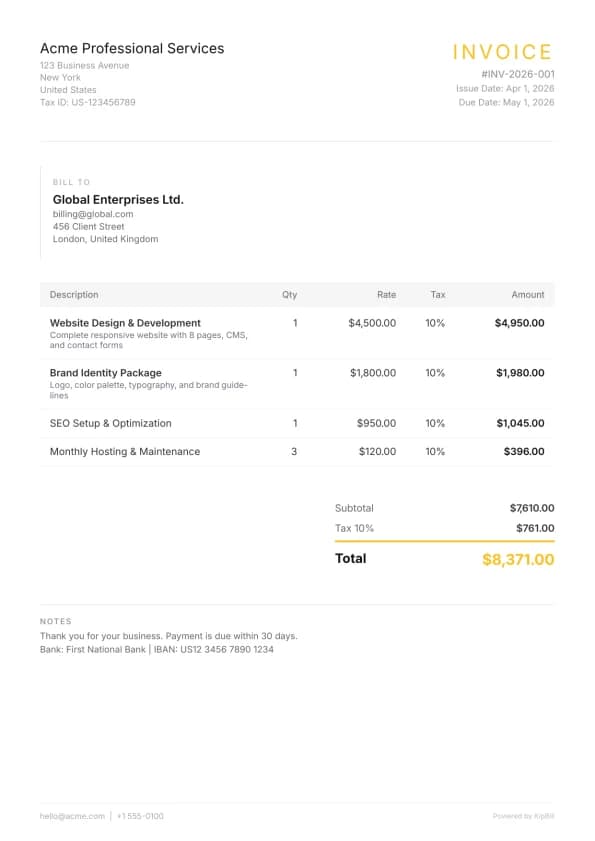
Invoicing for Cleaning Services: Billing for Recurring, Deep Cleans, and Move-In/Move-Out Jobs
Practical guide to cleaning service invoicing — how to price by square footage, bill for recurring schedules, handle supply charges, and invoice for deep cleans and move-in/move-out cleaning jobs.
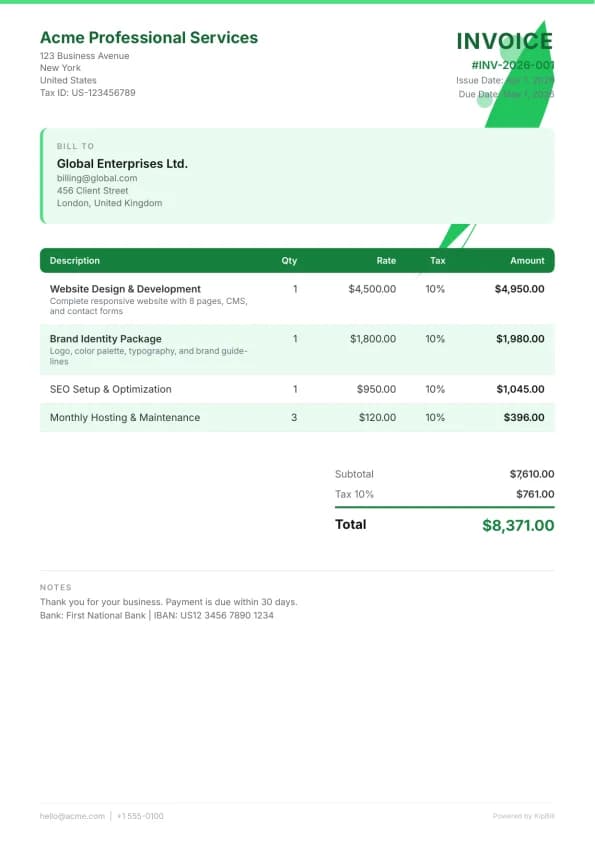
Invoicing for Landscapers: Seasonal Contracts, Material Costs, and Recurring Lawn Care Billing
Practical guide to landscaping invoice management — how to bill for seasonal contracts, one-time projects, plant and material costs, snow removal, irrigation work, and property size-based pricing.
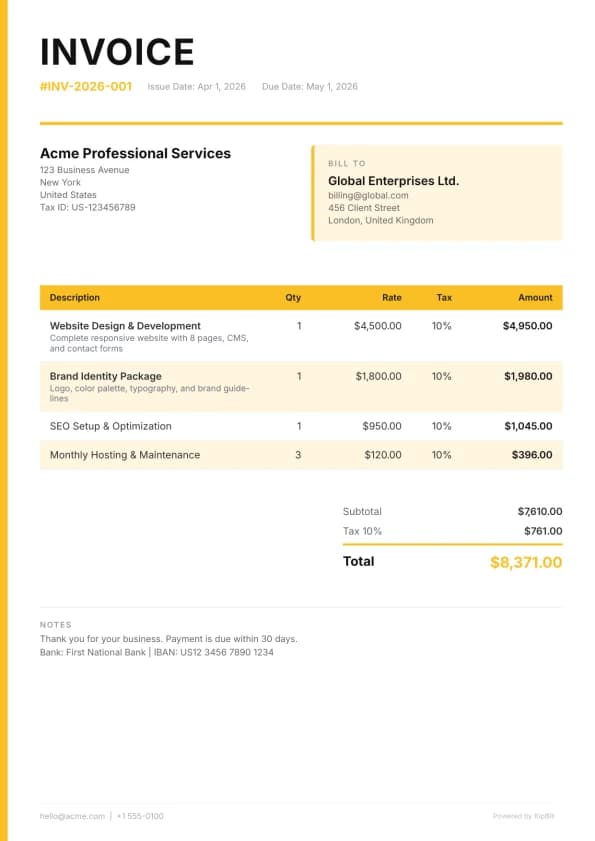
Plumbing Invoice Guide: How Plumbers Should Bill for Service Calls, Materials, and Emergency Work
Practical guide to invoicing for plumbers — emergency call-out fees, materials markup, flat rate vs time and materials, warranty work, inspection fees, and real invoice examples.
Start invoicing for free
Create professional invoices in minutes with KipBill, like freelancers and small businesses in 40+ countries.