Invoicing for Landscapers: Seasonal Contracts, Material Costs, and Recurring Lawn Care Billing
 KipBill Team
Landscaping is a business of extremes. Spring and summer bring a flood of work, fall is a transition, and winter means either snow removal revenue or a dead season depending on your location. Through all of it, your invoicing needs to keep pace — billing for recurring mowing, one-time installations, seasonal contracts, material costs, and specialty services like irrigation and hardscaping.
Most landscaping businesses start with a truck, a mower, and a handshake. But the ones that grow into profitable operations all share one thing: they invoice professionally, consistently, and on time. This guide covers how to structure landscaping invoices for every type of work you do. For foundational invoicing principles, see how to create a professional invoice.
Recurring Lawn Care: The Foundation of Landscaping Revenue
Weekly or biweekly lawn maintenance is the revenue engine of most landscaping businesses. It is predictable, scalable, and — when invoiced correctly — provides steady cash flow year-round.
Pricing by Property Size
The most transparent pricing model for lawn care is based on lot size. Clients understand it, it is easy to justify, and it scales logically.
Typical lawn care rates (mowing, edging, trimming, blowing):
- Under 5,000 sq ft: $35-$50 per visit
- 5,000-10,000 sq ft: $50-$80 per visit
- 10,000-20,000 sq ft: $80-$130 per visit
- 20,000-40,000 sq ft: $130-$200 per visit
- 1+ acre: $200-$400+ per visit
On the invoice, reference the property size so the pricing makes sense:
| # | Description | Qty | Unit Price | Total |
|---|---|---|---|---|
| 1 | Weekly lawn maintenance — 456 Elm Drive (approx 12,000 sq ft lot) — mow, edge, trim, blow | 4 | $95.00 | $380.00 |
Monthly vs Per-Visit Invoicing
For recurring lawn care, invoice monthly rather than per visit. Monthly invoicing is easier for both parties — the client knows what to expect each month, and you send 12 invoices per year instead of 30-40.
| # | Description | Qty | Unit Price | Total |
|---|---|---|---|---|
| 1 | Weekly lawn maintenance — April 2026 (4 visits: Apr 2, 9, 16, 23) | 4 | $95.00 | $380.00 |
| 2 | Spring fertilizer application (granular, 12,000 sq ft) | 1 | $85.00 | $85.00 |
| 3 | Pre-emergent weed treatment (spring application) | 1 | $65.00 | $65.00 |
| Total | $530.00 |
Set up automated recurring invoices that generate on the first of each month. Adjust visit counts based on the actual weeks in each month (some months have 5 weeks). This eliminates the single biggest cash flow problem in landscaping: forgetting to invoice for completed work during your busiest months when you are out working instead of doing paperwork.
Handling Skipped Visits
Weather cancellations, client vacations, and drought periods (when the lawn does not need mowing) all reduce the visit count. Your invoice must reflect actual visits performed, not the scheduled number. If you bill monthly, simply adjust the quantity. Include a note: "3 visits in July (1 skipped — client vacation week of July 14)."
Some landscapers use a fixed monthly rate regardless of visit count, averaging the cost over the full season. If you use this model, explain it in your service agreement and note it on the invoice: "Fixed monthly rate — April through October (28 scheduled visits averaged over 7 months)."
Seasonal Contracts: Structure and Billing
Seasonal contracts lock in clients for the full mowing season (typically April through October in northern climates, year-round in the south) and often include additional services beyond basic mowing.
What a Seasonal Contract Invoice Includes
A full-season contract might cover:
- Weekly mowing, edging, trimming, and blowing
- Spring and fall cleanup (leaf removal, bed preparation)
- Fertilization program (4-6 applications)
- Weed control (pre-emergent and post-emergent)
- Core aeration (fall)
- Overseeding (fall)
- Bush and hedge trimming (2-3 times per season)
You can invoice this two ways:
Option A: Monthly installments. Divide the total seasonal cost by the number of months. The client pays the same amount each month regardless of which services are performed that month. This is the smoothest cash flow model.
Example: $4,200 seasonal contract / 7 months = $600/month (April-October)
| # | Description | Qty | Unit Price | Total |
|---|---|---|---|---|
| 1 | Full-season lawn care contract — 789 Maple Ave (monthly installment 3 of 7) | 1 | $600.00 | $600.00 |
Reference: Season contract #SC-2026-045. Total contract value: $4,200.00. Paid to date: $1,800.00.
Option B: Itemized monthly billing. Bill each month for the specific services performed that month. This gives clients more detail but creates variable monthly amounts.
Off-Season Billing
In northern climates, the November-March gap creates cash flow challenges. Some landscapers extend the seasonal contract to 12 months at a lower monthly rate, covering the full year. Others invoice the full seasonal amount in fewer larger payments during the active months. Choose the approach that matches your cash flow needs and your clients' payment preferences.
One-Time Projects: Landscape Installation and Hardscaping
Beyond maintenance, landscape installation projects — patios, retaining walls, plantings, outdoor lighting, grading — require project-based invoicing with detailed material and labor breakdowns.
Material Costs: Transparency Builds Trust
Landscape materials represent 40-60% of project costs: plants, mulch, stone, pavers, topsoil, gravel, edging, landscape fabric, drainage supplies, and lighting fixtures. How you present these costs determines whether the client trusts your pricing.
Best practice: itemize major materials, bundle small items.
| # | Description | Qty | Unit | Unit Price | Total |
|---|---|---|---|---|---|
| 1 | Design and layout — front yard renovation | 1 | flat | $350.00 | $350.00 |
| 2 | Knockout rose bushes (3-gallon) | 8 | each | $28.00 | $224.00 |
| 3 | Emerald Green arborvitae (6 ft) | 5 | each | $95.00 | $475.00 |
| 4 | Premium hardwood mulch | 8 | cu yd | $55.00 | $440.00 |
| 5 | Landscape fabric (commercial grade) | 350 | sq ft | $0.35 | $122.50 |
| 6 | Drip irrigation supplies (tubing, emitters, timer, valve) | 1 | lot | $285.00 | $285.00 |
| 7 | Miscellaneous supplies (stakes, edging, topsoil amendments) | 1 | lot | $165.00 | $165.00 |
| 8 | Installation labor — 3-person crew | 16 | crew-hrs | $75.00 | $1,200.00 |
| 9 | Equipment (mini excavator rental, half day) | 1 | flat | $275.00 | $275.00 |
| 10 | Delivery fee (materials) | 1 | flat | $125.00 | $125.00 |
| Total | $3,661.50 |
Progress Billing for Large Projects
For projects over $3,000, use progress billing:
- Deposit (30-50%): Due before work begins. Covers material purchases and scheduling commitment.
- Mid-project (25-35%): Due after demolition, grading, and base materials are installed.
- Final (remaining balance): Due upon completion and client walkthrough.
Each progress invoice should reference the original proposal number and show the running total of payments made.
Plant Warranties
If you warranty plants (industry standard is 1 year for trees and shrubs), note this on the invoice: "Plant warranty: 1-year replacement warranty on all installed trees and shrubs, subject to proper watering per provided care instructions." This sets clear expectations and creates a reference document if a warranty claim arises.
Snow Removal: Seasonal or Per-Event Billing
For landscapers in northern climates, snow removal is the winter revenue stream. Invoicing for snow is unique because the workload is entirely weather-dependent.
Per-Push Billing
You invoice each time you plow, based on snowfall depth:
| Snowfall | Driveway (up to 60 ft) | Small parking lot (up to 10 spaces) | Large parking lot (10-50 spaces) |
|---|---|---|---|
| 2-4 inches | $45-$65 | $95-$150 | $200-$400 |
| 4-8 inches | $65-$95 | $150-$225 | $400-$700 |
| 8-12 inches | $95-$140 | $225-$350 | $700-$1,100 |
| 12+ inches | $140+ | $350+ | $1,100+ |
Per-push invoices need to document the date, approximate snowfall amount, and services performed (plowing, shoveling walkways, salting):
| # | Description | Qty | Unit Price | Total |
|---|---|---|---|---|
| 1 | Snow plowing — parking lot, 456 Commerce Dr (approx 6 inches, Jan 15 2026, 4:30 AM) | 1 | $185.00 | $185.00 |
| 2 | Sidewalk clearing — front and side walks (hand shovel + snow blower) | 1 | $65.00 | $65.00 |
| 3 | De-icing salt application — lot and walkways (approx 200 lbs) | 1 | $95.00 | $95.00 |
| Total | $345.00 |
Seasonal Snow Contracts
A fixed monthly fee (November-March) regardless of snowfall events. The client pays the same amount whether it snows twice or twelve times. This is better for client budgeting and gives you guaranteed winter revenue.
Monthly rates vary widely by region and property size. A typical residential driveway seasonal contract might be $150-$250/month for 5 months. A commercial parking lot could be $800-$2,500/month.
Invoice seasonal snow contracts the same way as seasonal lawn care: monthly installments referencing the contract number and total value.
Irrigation System Billing
Irrigation work — installation, spring startup, winterization, and repairs — requires specific invoicing treatment because of the mix of skilled labor, specialized parts, and water system considerations.
Installation Invoice
A new irrigation system involves design, trenching, pipe installation, heads, valves, a controller, and backflow preventer. Itemize the major components:
| # | Description | Qty | Unit Price | Total |
|---|---|---|---|---|
| 1 | Irrigation system design (6-zone residential, 8,500 sq ft coverage) | 1 | $250.00 | $250.00 |
| 2 | Hunter PGP rotary heads | 12 | $18.00 | $216.00 |
| 3 | Rain Bird 1804 spray heads | 24 | $6.50 | $156.00 |
| 4 | Hunter HC hydrawise controller (12-zone, WiFi) | 1 | $225.00 | $225.00 |
| 5 | Watts 007 1-inch backflow preventer | 1 | $165.00 | $165.00 |
| 6 | PVC pipe, fittings, wire, and valve boxes | 1 | $485.00 | $485.00 |
| 7 | Installation labor — 2-person crew | 14 | crew-hrs | $65.00 |
| 8 | Trenching (320 linear ft) | 1 | $425.00 | $425.00 |
| Total | $2,832.00 |
Seasonal Service Invoices
Spring startup and fall winterization are standard annual services. Invoice these as flat-rate line items:
| # | Description | Qty | Unit Price | Total |
|---|---|---|---|---|
| 1 | Irrigation spring startup — system activation, head adjustment, leak check (6 zones) | 1 | $125.00 | $125.00 |
| 2 | Replaced broken Hunter PGP head (zone 3, damaged over winter) | 1 | $24.00 | $24.00 |
Common Invoicing Mistakes Landscapers Make
These errors are widespread in the landscaping industry and collectively cost businesses thousands in lost revenue.
1. Not invoicing during peak season. May through August, you are working 60+ hours a week. Invoicing falls to the bottom of the priority list. By September, you have 6-8 weeks of unbilled work and no clear records of what was done. Set up automated invoicing before the season starts.
2. Undercharging for plant material. If you buy $500 worth of plants at wholesale and charge the client $500, you have done free purchasing, transportation, and handling. Mark up plants 30-50% to cover your time, fuel, vehicle wear, and the risk of plant loss in your nursery holding area.
3. Forgetting to bill for dump fees. Brush removal, old mulch disposal, and debris hauling generate dump fees that range from $25-$150 per load. Many landscapers absorb this cost accidentally because they pay the dump fee separately and forget to add it to the project invoice.
4. Vague material descriptions on installation projects. "Plants and materials — $2,400" will be questioned. "8 Knockout roses ($224), 5 arborvitae ($475), 8 yards mulch ($440), landscape fabric ($122), drip irrigation ($285), misc supplies ($165)" will not.
5. No weather documentation for snow removal. Per-push invoices should note the approximate snowfall amount and time of service. Without this, commercial clients may dispute charges, especially when there are multiple events in a single billing period.
6. Combining maintenance and project work on one invoice. If a recurring lawn care client also hires you for a $5,000 patio installation, issue separate invoices. Combining them confuses the client's budgeting (maintenance is an operating expense, the patio is a capital improvement) and complicates your own revenue tracking.
Tax Considerations for Landscaping
Landscaping tax rules vary by state and affect how you structure invoices.
Sales Tax on Landscaping Services
In many states, landscaping services (mowing, trimming, maintenance) are taxable, while in others they are exempt. Installation of plants and materials may be taxed differently than maintenance services. Some states tax the materials portion of a landscaping job but not the labor. Check your state revenue department for specific rules.
Materials Resale
When you buy materials (plants, mulch, stone, pavers) for installation in a client's property, you may be able to purchase them tax-exempt using a resale certificate and then charge the client sales tax on the materials as part of the invoice. This varies by state. Consult your accountant to set up the correct tax structure.
Start invoicing for free
Create professional invoices in minutes with KipBill, like freelancers and small businesses in 40+ countries.
Growing Your Landscaping Business Through Professional Invoicing
The difference between a $50,000/year solo operation and a $500,000/year landscaping company often comes down to business systems, and invoicing is the most important one. Here is what professional landscaping invoicing looks like:
- Automated recurring invoices generated on the first of each month for all maintenance clients
- Standardized templates for each service type (lawn care, installation, snow removal, irrigation)
- Online payment links on every invoice — clients who can pay by tapping a link pay 3-5x faster than clients who have to write checks
- Automatic payment reminders at 7, 14, and 30 days past due
- Branded, professional formatting that matches your truck wraps, uniforms, and website
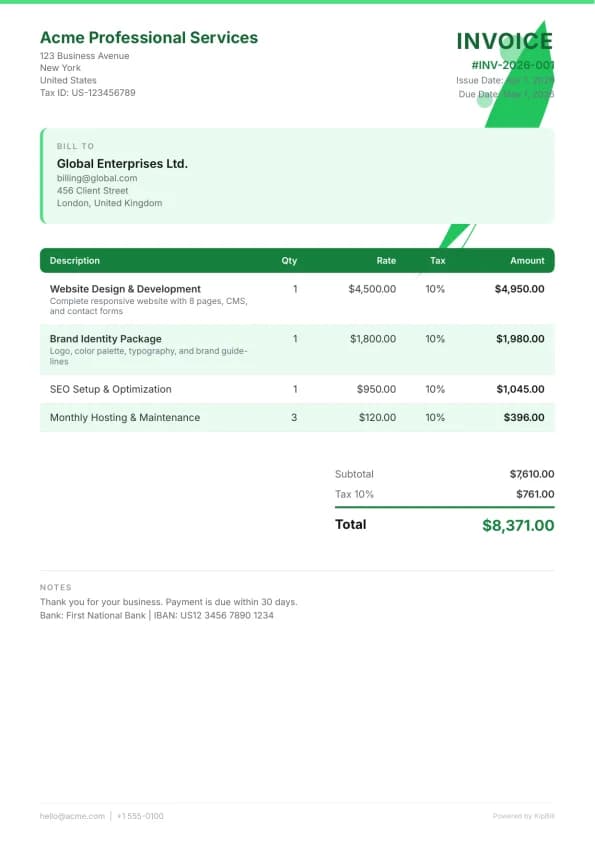
If your invoicing is still a manual process, start with KipBill's free invoice generator to see what professional landscaping invoices look like. For recurring billing and automated reminders, explore our invoice software for landscapers. And to save time during the busy season, our AI invoicing assistant can draft invoices from a quick description of the work completed.
Frequently Asked Questions
How should landscapers bill for extra services requested during a regular maintenance visit?
Add extra services as separate line items on the monthly invoice with a note indicating the date they were performed. For example: "Hedge trimming — requested on-site Apr 16 — 12 boxwood shrubs, front beds." Always confirm the price with the client before performing add-on work, even if it is a small amount. Getting verbal approval and sending a quick text confirmation protects you from disputes.
What is the best way to handle a landscaping client who consistently pays late?
First, make sure your invoices have clear payment terms (Net 15 or Net 30). Set up automatic payment reminders. If the problem persists, switch the client to payment-in-advance: require payment before the first visit of each month. This is completely reasonable and common in the industry. For commercial clients, charge a late payment fee (1.5% per month is standard) and note it on your invoice terms.
Should landscapers offer discounts for prepaying the full season?
A 5-10% discount for full-season prepayment can be worthwhile because it eliminates collections risk and gives you capital to invest in equipment and materials before the season starts. Show it on the invoice: "Full-season prepayment discount (7%) — $294.00 credit on $4,200.00 annual contract." However, only offer this if your cash flow can handle performing the work months after receiving payment.
How do I invoice for landscaping work where the client provides their own plants or materials?
Invoice only for labor, equipment, and any materials you supplied. Note the client-supplied materials on the invoice for documentation: "Client-supplied materials: 6 Japanese maple trees, 20 bags premium mulch. Installation labor only — no warranty on client-supplied plant material." This protects you if client-purchased plants fail due to poor stock quality.
What payment terms are standard in the landscaping industry?
Residential clients: Net 15 or due upon receipt. Commercial clients and property management companies: Net 30 (some large companies push for Net 45-60, but resist this if possible — it kills cash flow). Always state terms on the invoice. For new clients, consider requiring the first month's payment upfront before starting service to verify they are reliable payers.

KipBill Team
Related Articles
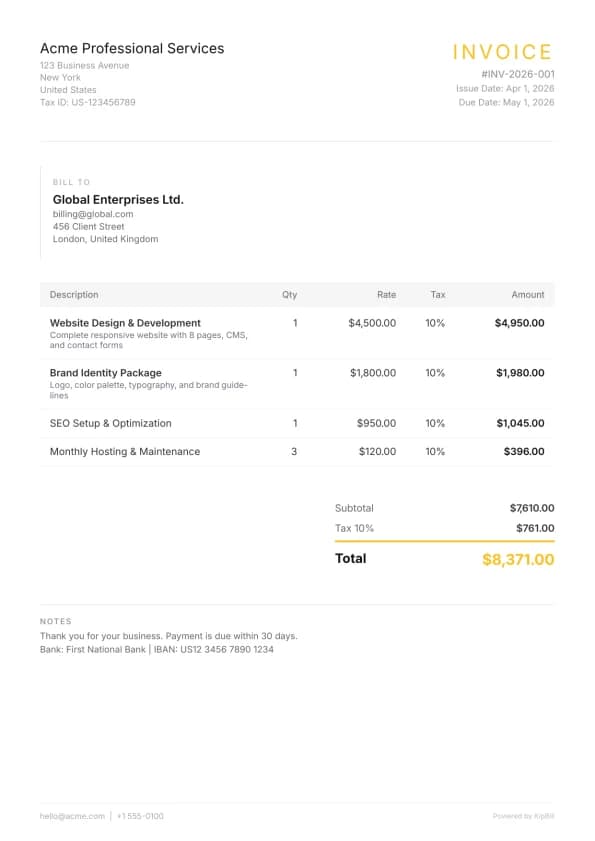
Invoicing for Cleaning Services: Billing for Recurring, Deep Cleans, and Move-In/Move-Out Jobs
Practical guide to cleaning service invoicing — how to price by square footage, bill for recurring schedules, handle supply charges, and invoice for deep cleans and move-in/move-out cleaning jobs.
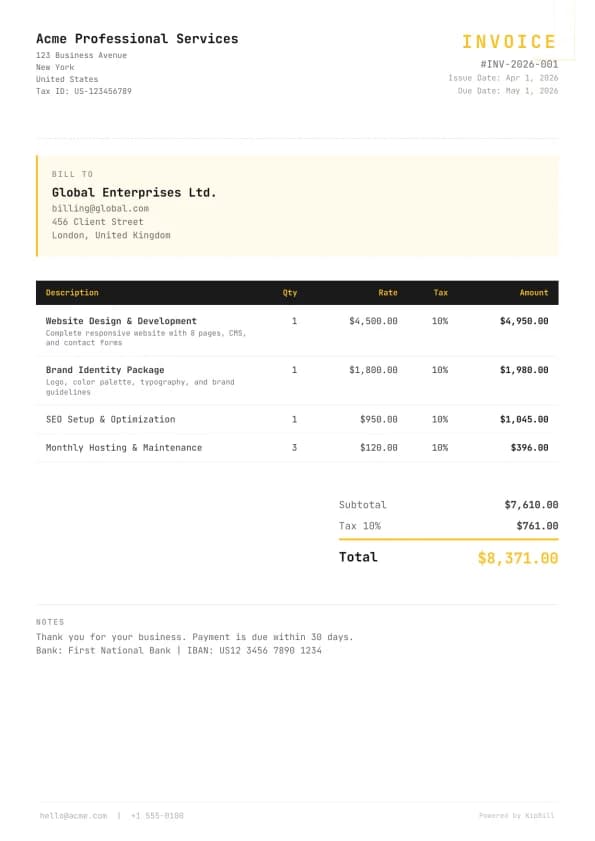
Invoicing for Electricians: How to Bill for Service Calls, Projects, and Permit Fees
Complete guide to electrical contractor billing — how to handle material markup, permit fees, service call rates, progress billing for large projects, and safety inspection charges on your electrician invoices.
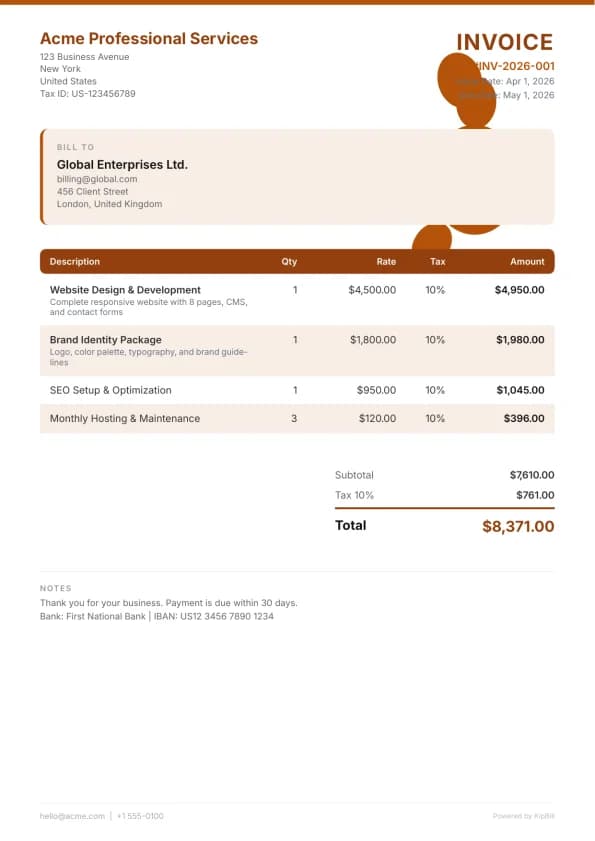
Invoicing for Veterinarians: Billing for Procedures, Medications, and Wellness Plans
Complete guide to veterinary invoicing — how to itemize procedures and medications, bill for emergency after-hours care, structure wellness plans, handle lab work charges, and process pet insurance claims.
Start invoicing for free
Create professional invoices in minutes with KipBill, like freelancers and small businesses in 40+ countries.