How to Invoice as a Freelancer: Step-by-Step Guide
 KipBill Team
To invoice as a freelancer, agree on your rate and payment terms before you start. Then, when you deliver, send the client a numbered invoice with your details and theirs, what you did, the amount, any tax, a due date and how to pay. Below are the seven steps with a worked example, followed by everything that decides how fast you get paid: payment terms, late fees, retainers and clients abroad.
How to invoice as a freelancer in 7 steps
1. Agree on the terms before you start
Put your rate, what is included, the deposit (if any) and the payment terms in writing: a short email the client replies "agreed" to is better than nothing, and a contract is better still. Your invoice will only repeat what you agreed here.
2. Get the client's billing details
Ask for the company's legal name, billing address, the email of whoever pays invoices (often accounts payable, not your contact), and a purchase order (PO) number if they use one. Large companies reject invoices without a PO.
3. Give the invoice a unique number
Number invoices in sequence and never reuse a number: INV-2026-001, INV-2026-002, and so on. Tax authorities expect it, and it makes your own bookkeeping simple.
4. Describe the work line by line
One line per deliverable or block of hours, with quantity, rate and amount. "Design work — $2,400" invites questions; "Homepage and 4 inner pages, responsive (Oct 1–14) — 1 × $2,400" does not.
5. Add tax only if it applies to you
Whether you charge sales tax, VAT or GST depends on where you are, what you sell and to whom. In most US states, professional services such as writing, design or consulting are not subject to sales tax; in the EU and UK you charge VAT once you are VAT-registered. If you are in the UK, our guide to invoicing as a self-employed freelancer in the UK covers exactly what your invoice must show.
6. Set a due date and say how to pay
Write a calendar date ("Due: October 29, 2026"), not just "Net 14". Add your bank details or a payment link so the client never has to ask how to pay.
7. Send it the day you deliver, then follow up
Email the invoice as a PDF the same day you hand over the work. If it is not paid by the due date, send a polite reminder the day after; our late payment email templates give you the wording.
Example: a freelance invoice
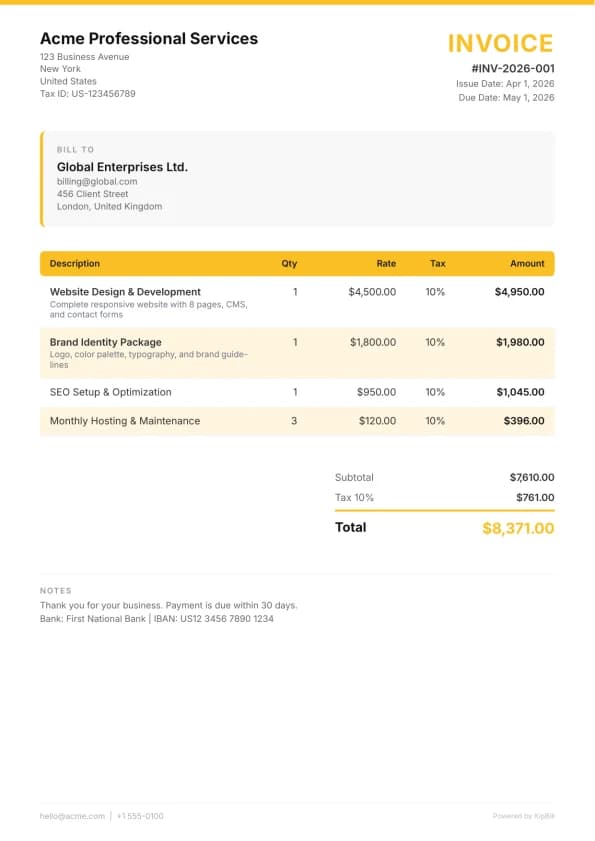
Here is what a simple invoice from a freelance web designer to a small company looks like:
| From | Maya Ortiz Design, 41 Elm Street, Austin, TX 78701 · maya@example.com |
| Bill to | Northwind Coffee LLC, Accounts Payable, 200 Market Street, Denver, CO 80202 |
| Invoice number | INV-2026-014 |
| Invoice date | October 15, 2026 |
| Due date | October 29, 2026 (Net 14) |
| PO number | PO-7781 |
| Description | Qty | Rate | Amount |
|---|---|---|---|
| Website redesign: homepage + 4 inner pages (Oct 1–14) | 1 | $2,400.00 | $2,400.00 |
| Copy edits and image sourcing | 6 h | $60.00 | $360.00 |
| Less: 50% deposit received Sept 30 (INV-2026-011) | −$1,380.00 | ||
| Total due | $1,380.00 |
Payment: bank transfer to the account shown below, or the payment link in the email. Late payments: 1.5% per month on the overdue balance.
There is no tax line in this example. Whether your service is taxable depends on your state or country, so check with your tax authority before your first invoice.
You can build this exact invoice in the free invoice generator: fill in the form, see the PDF update live and download it. No account needed.
The rest of this guide goes deeper into each decision, from your first client to long-term retainers and international contracts.
The Anatomy of a Professional Freelance Invoice
Before diving into strategy, let us establish what belongs on every freelance invoice. Missing any of these elements introduces friction, delays, or disputes. Our detailed guide on how to create a professional invoice covers the basics, but here is the freelancer-specific checklist:
Required Elements
- Your business name and contact information — Even if you are a sole proprietor operating under your own name, treat this professionally. Include your address, email, phone, and website.
- Client's business name and contact information — Match this to their legal entity name, not just the contact person's name. This matters for their accounts payable department and for your records.
- Invoice number — Sequential, unique, and consistent. Use a format like "INV-2026-001" that includes the year. Never reuse numbers.
- Invoice date — The date you are issuing the invoice.
- Due date — Not "Net 30" buried in fine print. A specific calendar date: "Due: May 5, 2026." This removes ambiguity.
- Line items with descriptions — What you did, when you did it, and the rate. "Web design — $3,000" is lazy. "Website design and development — 5-page responsive site with contact form, blog integration, and SEO setup (March 10–28, 2026)" is professional.
- Quantities and rates — Whether you bill hourly, per project, per word, or per deliverable, show the math.
- Subtotal, taxes, and total — Applicable sales tax, VAT, or GST clearly broken out.
- Payment instructions — Bank account details, PayPal address, Stripe link, or whatever payment methods you accept. Do not make the client email you to ask how to pay.
- Payment terms and late fee policy — We will cover these in detail below.
Optional but Recommended
- Project or purchase order number — Corporate clients often require this for their internal processing.
- Payment link — A clickable link to pay online reduces friction dramatically. Clients are more likely to pay immediately if they can do it in two clicks.
- Notes or thank-you message — A brief, human note at the bottom ("Thank you for your business — it was great working on this project") adds a personal touch without being unprofessional.
Setting Payment Terms That Actually Work
Payment terms are the single most important factor in how quickly you get paid. Most freelancers default to Net 30 because that is what they have seen, without considering whether it serves their interests.
The Problem with Net 30
Net 30 means the client has 30 days to pay after receiving the invoice. For a freelancer, this creates a cash flow gap of 30–60 days or more between completing work and receiving payment (factoring in the time to invoice after project completion and the client's tendency to pay at the deadline, not before).
Net 30 exists because large corporations need it for their accounts payable cycles. If your clients are Fortune 500 companies, you may have no choice. But if your clients are small businesses, startups, or individuals, you can — and should — negotiate better terms.
Better Alternatives
- Due on receipt — Payment expected immediately upon receiving the invoice. Best for small projects and individual clients.
- Net 7 or Net 14 — A reasonable middle ground. The client gets a short grace period, and you get paid within two weeks.
- 50% upfront, 50% on completion — The gold standard for project-based freelance work. You never do more than half the work without payment.
- Milestone billing — For large projects, break payment into 3-4 milestones tied to deliverables. Each milestone has its own invoice due on delivery.
How to Present Your Terms
State your payment terms before starting work — in your proposal, contract, or scope document. Then restate them on every invoice. Never assume the client remembers or will refer back to the contract.
On the invoice, make the due date impossible to miss. Put it near the top, next to the total amount, in bold. "Payment due: April 20, 2026" is clearer than "Terms: Net 14" because the client does not have to do math.
The single best thing you can do to get paid faster is to send the invoice the moment the work is delivered — not the next day, not at the end of the week, not when you "get around to it." The client's attention and satisfaction are highest at the moment of delivery. Every day you delay invoicing is a day the urgency to pay decreases.
Late Fees: How to Set Them and When to Enforce Them
Late fees serve two purposes: they compensate you for the time value of money you are owed, and they incentivize timely payment. The second purpose is more important than the first.
Standard Late Fee Structures
- Percentage-based: 1.5% per month on the outstanding balance (18% annualized). This is the most common structure; some states and countries cap late-payment interest, so check your local limit.
- Flat fee: A fixed amount (e.g., $25 or $50) added after the due date. Simpler but less proportional to the invoice size.
- Escalating: 2% after 30 days, 5% after 60 days. This creates increasing urgency.
How to State Late Fees on Your Invoice
Include a line at the bottom of every invoice: "A late fee of 1.5% per month will be applied to balances outstanding beyond the due date." This puts the client on notice and establishes the terms as part of the transaction.
When to Actually Enforce Late Fees
Here is the honest truth: most freelancers never enforce late fees because they are afraid of damaging the client relationship. The fee's real value is as a deterrent. Clients who see a late fee policy on your invoice are more likely to pay on time because the cost of not doing so is explicit.
That said, if a client is consistently late — paying 15 or 30 days past due on every invoice — you should apply the fee. Send the next invoice with the late charge from the previous invoice as a line item. If the client objects, you can waive it as a one-time courtesy while making clear that future late payments will include the fee. This establishes a boundary without scorching the relationship.
The Retainer Model: Predictable Income for Freelancers
Retainers are the closest thing freelancers have to a salary, and structuring them correctly on your invoices is crucial.
How Retainers Work
A retainer is an advance payment for a set amount of work over a defined period. The client pays at the beginning of the month (or quarter), and you deliver the agreed-upon scope during that period.
Retainer Invoice Structure
Your monthly retainer invoice should include:
- Retainer period (e.g., "April 2026")
- Scope description (e.g., "Up to 20 hours of design work, including up to 2 revision rounds per deliverable")
- Retainer fee
- Overage rate (what you charge per hour or per deliverable beyond the retainer scope)
- Any overages from the previous period as a separate line item
Example: Monthly Design Retainer — April 2026 (up to 20 hours) — $4,000 March 2026 Overage (3.5 hours @ $225/hr) — $787.50 Total due — $4,787.50
Handling Unused Retainer Hours
State your policy clearly: unused hours do not roll over. The retainer fee compensates you for reserving capacity, not just for hours worked. If you allow rollover, clients will bank hours during slow months and dump work on you during busy ones, destroying your scheduling predictability — which is the entire point of a retainer.
When to Increase Retainer Rates
Review retainer agreements annually. If your rates have increased, if the client's scope has grown, or if you are consistently hitting overage, the retainer needs adjustment. Give 30-60 days notice before the new rate takes effect, and update your invoice template accordingly.
Invoicing International Clients
International freelancing is increasingly common, and it introduces invoicing complexities that domestic work does not have.
Currency Considerations
You have three options for billing international clients:
- Invoice in your currency — The client bears the exchange rate risk. This is simplest for you but can create friction.
- Invoice in the client's currency — You bear the exchange rate risk, but the client sees a familiar number and is more likely to pay promptly.
- Invoice in a major currency (USD, EUR) — A common middle ground when neither party uses a major currency.
Whichever you choose, state the currency clearly on the invoice. "$5,000" is ambiguous if you are in Canada billing a US client. "5,000 USD" is not.
Multi-Currency Invoicing
If you work with clients in multiple countries, you need invoicing software that handles multi-currency billing: the right currency symbol and format, and payments tracked in each currency. KipBill for freelancers supports 31 currencies and 12 languages, and each client can have their own currency and language.
VAT, GST, and International Tax
The rules for cross-border service taxation are jurisdiction-specific, but the general principles are:
- B2B services exported outside your country are usually zero-rated for VAT/GST (you do not charge it, but you note the exemption on the invoice)
- B2C services may be taxable in the client's country under certain thresholds
- EU reverse charge mechanism — If you are in the EU billing another EU business, the client self-assesses VAT. Your invoice should note "Reverse charge applies" and include the client's VAT number.
- US freelancers — Generally, you do not charge sales tax on services provided to foreign clients, but you still report the income.
Always include the appropriate tax note on international invoices. "VAT zero-rated — export of services to non-EU client" or "Reverse charge — Article 196, EU VAT Directive" protects both parties.
Getting Paid Internationally
International wire transfers can be expensive ($25-$50 per transaction) and slow (3-5 business days). Better options include:
- Wise (TransferWise) — Low fees, real exchange rates, local account details in multiple countries
- PayPal — Universal but expensive (fees of 3-5% on international transactions)
- Stripe — If you send a payment link, the client can pay by card regardless of their country
- Direct bank transfer with local details — Services like Wise give you local bank details in the US, UK, EU, and other regions, so the client pays as if it were a domestic transfer
List at least two payment options on your invoice to give international clients flexibility.
Contracts and Invoices: How They Work Together
Your invoice is not your contract, and your contract is not your invoice. They serve different purposes, but they must align.
What the Contract Covers
- Scope of work
- Timeline and milestones
- Payment schedule and terms
- Intellectual property ownership and usage rights
- Revision limits
- Cancellation and termination clauses
- Liability limitations
What the Invoice Covers
- The specific work delivered (referencing the contract's scope)
- The amount due based on the contract's payment terms
- The due date
- Payment instructions
The Critical Link
Your invoice should reference the contract. Include a line like "Per agreement dated March 1, 2026" or the contract/project number. This connects the invoice to the legal agreement and makes disputes easier to resolve because both documents are linked.
If the scope changes mid-project (and it will), update the contract with a change order before invoicing for the additional work. Invoicing for work that is not covered by the contract — even if the client verbally approved it — puts you in a weak position if they refuse to pay.
Start invoicing for free
Create professional invoices in minutes with KipBill, like freelancers and small businesses in 40+ countries.
Taxes Every Freelancer Needs to Understand
Taxes are the part of freelancing that nobody enjoys but everybody must handle. Your invoicing practices directly affect your tax situation.
Quarterly Estimated Taxes
In the US, freelancers owe quarterly estimated taxes (federal and often state) if they expect to owe more than $1,000 in tax for the year. Your invoices are your income records — if they are accurate and up to date, calculating quarterly estimates is straightforward. If they are scattered, incomplete, or inconsistent, you are guessing.
Self-Employment Tax
US freelancers pay self-employment tax (15.3% for Social Security and Medicare) on net earnings. This is in addition to income tax. Many new freelancers are shocked by this. Proper invoicing and expense tracking gives you accurate net earnings so you can set aside the right amount throughout the year.
Sales Tax on Services
Whether you need to charge sales tax depends on your jurisdiction and the type of service. Most US states do not tax professional services (design, writing, consulting), but some do. Digital products and SaaS are increasingly taxed. If you are required to collect sales tax, it must appear as a separate line item on your invoice.
Record Keeping
The IRS requires you to keep financial records for at least three years (seven years for some situations). Every invoice you send is a record. Every invoice you pay is a deductible expense receipt. Using proper invoicing software creates an automatic, organized archive that satisfies these requirements without you maintaining a filing cabinet.
Seven Strategies to Get Paid Faster
Beyond proper invoicing, these tactical approaches accelerate payment:
1. Require Deposits
Never start work without a deposit. For project-based work, 50% upfront is standard. For larger projects, 30-40% upfront with milestone payments works well. The deposit invoice should be the first thing the client receives after signing the contract.
2. Offer Early Payment Discounts
A 2% discount for payment within 7 days (noted as "2/7 Net 30" on the invoice) costs you very little but motivates faster payment. For a $5,000 invoice, the client saves $100 by paying three weeks early. Many will take the deal.
3. Make Payment Easy
Include a direct payment link on every invoice. The fewer steps between "I should pay this" and "I paid this," the faster you get paid. On KipBill's Pro plan, invoices can include a Stripe payment link so clients pay by card, with no KipBill commission.
4. Automate Payment Reminders
Do not manually chase overdue invoices. Set up automatic reminders that go out 3 days before the due date, on the due date, and 7 days after. This removes the emotional burden of asking for money and ensures consistent follow-up. KipBill sends automatic reminders from the Starter plan, and you can also ask its AI invoicing assistant to send one.
5. Invoice Immediately
Send the invoice the moment you deliver the work. Not tomorrow. Not Friday. Now. Speed of invoicing directly correlates with speed of payment.
6. Use View Tracking
Knowing whether the client has opened your invoice tells you whether to follow up with a gentle reminder ("Just checking you received the invoice") or a payment-focused message ("The invoice is now 7 days past due"). You cannot make this distinction if you do not know whether they have seen it.
7. Withhold Deliverables Until Payment
For final deliverables — completed websites, final design files, finished manuscripts — do not hand over the final versions until payment is received. Deliver a watermarked preview, a staging link, or a review copy. The final, usable deliverable is released upon payment. State this policy in your contract and on your invoice.
Common Freelance Invoicing Mistakes
These are the errors that lead to late payments, disputes, and tax problems:
-
Invoicing late. Every day between project completion and invoice delivery is a day you are working as an unpaid lender to your client. Invoice immediately.
-
Vague line items. "Consulting — $2,000" invites questions. "Brand strategy consultation — 8 hours @ $250/hr (market research, competitor analysis, positioning document)" does not.
-
No deposit requirement. Starting a $10,000 project with zero payment upfront is a $10,000 bet on the client's goodwill. Protect yourself.
-
Inconsistent numbering. Skipping numbers, reusing numbers, or using random formats makes accounting impossible and looks unprofessional.
-
No payment instructions. If the client has to email you to ask how to pay, you have added friction and delay. Put bank details or a payment link on every invoice.
-
Not tracking time accurately. If you bill hourly, your invoice is only as accurate as your time tracking. Use a timer, not your memory. Estimating hours after the fact always undercharges — you forget the small increments of email, revisions, and research.
-
Ignoring international tax obligations. Billing a client in another country without understanding the tax implications can result in unexpected liabilities. Research the rules before you send the first invoice.
Putting It Together
Freelance invoicing is a skill, and like any skill, it improves with intentional practice. The freelancers who get paid reliably and on time are not the ones with the best collection agencies — they are the ones with clear payment terms communicated upfront, professional invoices sent immediately upon delivery, deposit requirements that protect their cash flow, and automated follow-up that removes the emotional burden of chasing money.
You do not need to implement everything in this guide at once. Start with the highest-impact changes: require a deposit on your next project, send the invoice the same day you deliver, and include a payment link. These three changes alone will measurably improve your cash flow.
For building your first professional invoice, try our free invoice generator — no account required. When you are ready for automated recurring invoices, multi-currency support, payment tracking, and AI-powered invoice creation, explore KipBill for freelancers. For more invoicing strategies specific to freelancers, read our companion article on invoicing tips for freelancers, and check out our late payment email templates for ready-to-use follow-up messages.
Frequently Asked Questions
How do I invoice a company for freelance work?
Ask for the company's legal name, billing address, accounts payable email and PO number before you send anything. Then send a numbered invoice addressed to the company (not to your contact), with the PO number, a line-by-line description of the work, the total, a calendar due date and your payment details. Send it to accounts payable and copy your contact.
What payment terms should a new freelancer use?
Start with 50% upfront and 50% on delivery for project-based work. This protects you from non-payment while being reasonable for the client. As you build trust with a client over multiple projects, you can adjust — but never move to fully post-delivery payment unless the client has a proven track record of paying on time. For ongoing work, Net 14 is a good default.
How do I handle a client who consistently pays late?
First, ensure your invoicing process is airtight — clear due dates, late fee policy stated, reminders automated. If the client still pays late, have a direct conversation: "I have noticed the last three invoices were paid 2-3 weeks past due. Going forward, I will need to move to 100% upfront payment to continue working together." This is not confrontational — it is a business decision.
Should I charge sales tax on my freelance invoices?
This depends entirely on your jurisdiction and the type of service you provide. In most US states, professional services like design, writing, and consulting are exempt from sales tax. However, some states tax certain services, and digital products are increasingly taxable. Consult your state's tax authority or an accountant for your specific situation. If you are required to collect it, always list it as a separate line item.
How do I invoice international clients in different currencies?
Use invoicing software that supports multi-currency billing. State the currency clearly on the invoice (e.g., "5,000 USD" not just "$5,000"). Decide whether to bill in your currency or the client's — billing in the client's currency reduces friction on their end. Include international payment options like Wise or Stripe to avoid expensive wire transfer fees for both parties.
Is it legal to withhold deliverables until the client pays?
Generally, yes — provided your contract supports it. Most freelance contracts include a clause stating that intellectual property transfers upon full payment. Your invoice can reinforce this: "Final deliverables released upon receipt of full payment." This is standard practice across creative and professional services industries. However, review your specific contract and local laws, as enforcement varies by jurisdiction.

KipBill Team
Related Articles

Photography Invoice: What to Include and Charge
How to write a photography invoice: required details, deposits, usage rights and payment terms for event and wedding photographers. Create yours for free.
Invoicing for Personal Trainers and Gyms: Session Packages, Memberships, and Getting Paid Reliably
A complete guide to invoicing for personal trainers, gym owners, and fitness professionals. Learn how to bill for session packages, memberships, group classes, online coaching, and more.

Consultant Invoice Guide: How to Bill Clients Professionally and Get Paid Faster
Practical guide to consulting invoices — hourly, project-based, and retainer billing structures, expense pass-throughs, milestone invoicing, and payment terms.
Start invoicing for free
Create professional invoices in minutes with KipBill, like freelancers and small businesses in 40+ countries.